
Every picture has a story
Friday, November 23, 2012


Saturday, November 03, 2012
Auction faces soft season
 |
| coaxing a bid |
 |
| Top bid |
"People certainly got some good deals," said Jackie Sweeney, Hylee Farm owner. "I don’t know. It’s an election year."
It’s not that horses didn’t sell; the top bid was more than $17,000. It was the horses that earned only the minimum $750 bid or didn’t sell at all for failure to make the floor. Internet bidding pitted buyers against each other from as far away as British Columbia and provided a boost on several lots.
The sale arena at the Mount Horeb farm was near seating capacity with consigners, potential bidders and onlookers. At the preview event the night before, the barn aisles were crowed with people sizing up the offerings and taking test rides to see if the animals fit the rider. The interest level was high and the excitement was evident.
There was obvious surprise when the sale began sluggishly and continued to drag along in the early going. Auctioneer Bill Addis of Edmond, Okla., repeatedly prodded the crowd, frequently pausing the bidding to talk up the horse, answer questions and let the consigners show off the best of their animals.
"You’ll regret not bidding in the morning," Addis said.
What isn’t good for the seller certainly benefits the buyer as people picked up top-end animals for less than what it cost to raise and train them. Unofficially, out of the 41 lots consigned, 34 lots sold with a couple of scratches.
The low bid for a 4-year-old mare was $550 and one horse went through the auction ring without a bid. Four other lots were held by consignors for not reaching the pre-assigned minimum bid, one of which did reach $6,000 before Addis called it.
The unofficial sale total was $71,700 for an equally unofficial average of $2,100 per lot. By way of comparison, last year’s production sale auction total was $115,500 on 35 head. The auction average on horses sold was $3,300.
An obvious question about the state of the market related to the drought and the short supply of pasture and hay across the nation. Sweeney tended to discount the forage situation as a factor in the sale. She said most of the people interested in such high-quality animals have secured their hay supplies for the season and if they want a horse they’ll bid.
Other people speculated that the shortage of forage and pasture are part of an overall picture that includes a slow economy, an evolving horse business, election year fatigue, contraction in the business and an overall sense of uncertainty. More than one attendee at the sale pointed out the number of stables around the country that are scaling back by reducing inventory.
"Eventually, this cutting back we see in the business now will lead to a shorter supply of good horses," said Joe Doctor, one of the sale ring men. "It’s a supply and demand thing, and we’ll see prices come back once that has happened."
Monday, October 29, 2012
Lettering in horsemanship: High school competition growing
 |
| Competition during district two show |
"You can now get a high school athletic letter in horsemanship," said Jill Klubertanz, WIHA district 2 chairwoman. "School districts that recognize the sport can, if they want, offer a letter to participants."
Since its inception in 2007, WIHA has grown from 17 teams across the state to more than 60 teams with more than 300 students participating, said Julia Lepinski, WIHA president. Its growth is partly connected to the team aspect of the competitions.
"You’re part of a team. There are no individual awards. When you compete, you’re helping your team and everyone is cheering and helping each other along," Lepinski said.
Anything connected to high school-sanctioned sports tends to get complicated, but the WIHA tries to make it as easy on school districts as possible to recognize the sport, she said. A big hurdle to adding more sports is money, so WIHA activities and events are completely self-funded.
"The students take on all the costs of having the animals and the transportation," Klubertanz said. "The association takes care of the various liability issues that a school district is usually concerned about. There’s no cost to the school district for having a team."
Wisconsin is divided into 18 districts and students may form teams regardless of whether a school district decides to recognize horsemanship as a lettered sport. Divisions within WIHA are based on the number of riders from a school district: Division A, 11-15 riders; Division B, 6-10 riders; Division C, 3 to 5 riders; Division D, 1-2 riders.
Teams then compete in district shows for the chance to go to the state show. The top two teams from each district division earn the chance to go to the state show. There’s a smorgasbord of 18 competitive WIHA classes such as: western showmanship, hunter hack equitation, reinsmanship, barrels and relay races.
Teams pick six of the available classes in which to compete. The show competition is similar to a track meet where athletes may compete in more than one event, Klubertanz said. Team scores are added up to determine team winners.
"There are individual ribbons, but at the end there is only a team trophy," she said.
"Our season is short; September and October," Klubertanz said. "Each district does three shows. If it’s a small district they may combine shows. It’s unique that we judge only the rider’s ability. The kind of horse a student has doesn’t matter."
Why should youth want to get involved with another high school activity when there already are so many to choose from? Klubertanz says many young people with equestrian interests are so wrapped up with their horses and horse activities that they often forego other high school athletics and programs.
"The students with horses are putting in all the work and making all the sacrifices and learning many of the same lessons as other athletes," she said. "The WIHA gives them the opportunity to get some credit for their work so they use it on college applications and resumes like other students do."
The official association purpose statement reads in part, "...to promote continuous growth in programs fostering horsemanship education, sponsor activities to encourage interscholastic participation and to have cooperative adult supervised leadership (coaching) for all students in grades 6 through 12 who are desirous to participate regardless of race, creed or national origin and meets the association rules and regulations."
Saturday, September 22, 2012

Wednesday, August 15, 2012
Watering back a drought

Saturday, July 14, 2012

Saturday, July 07, 2012

Environmental portraits continue
Feeding hay in January, Wheatland, Wyoming.
 | |
| ©John Deere/NetAgra Sevie Kenyon |

Friday, June 01, 2012
Another location portrait
 |
| Photo taken for UW-Madison College of Agricultural and Life Sciences. |
Tuesday, May 29, 2012
Location portrait
 |
| John Mochon, program manager of the Small Grains Breeding Program in the UW-Madison agronomy department |
“The biggest thing that stands out about this new variety, BetaGene, is that it’s both a high yielding variety and high in beta glucan. Beta glucan is a heart-healthy chemical that is exclusive to oats,” says John Mochon, program manager of the Small Grains Breeding Program in the UW-Madison agronomy department. 3-minute audio here... Read more...
Sunday, May 20, 2012

Tuesday, May 08, 2012
Covered bridge in the morning fog
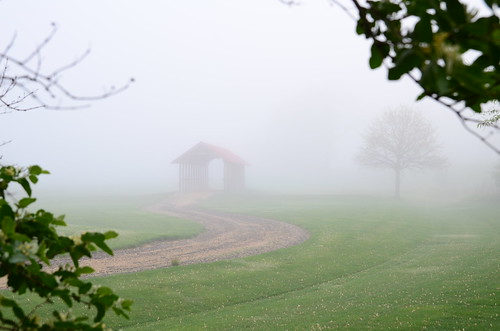
A special covered bridge was built to cross over a waterway at the UW-Madison O.J. Noer turf research facility.
Friday, April 06, 2012
Grape bud escapes frost
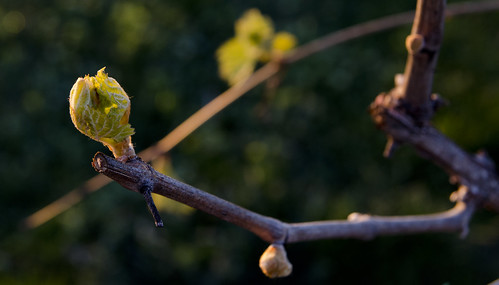
Not until May 15 are we past last frost date. Yet, our season is well underway. Close call at 29 degrees this morning
Monday, April 02, 2012
Monday, March 26, 2012
Peach blossoms 3-25-12
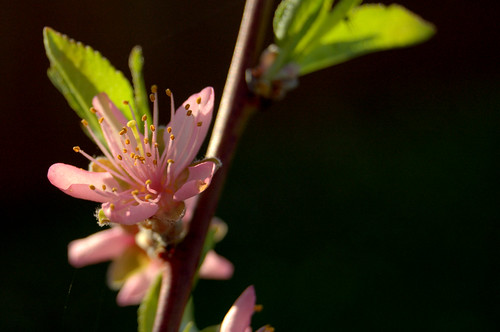
A peach tree here is unusual. Peach blossoms in March unheard of. In the 10-12 years I've been aware of this tree it has had fruit twice.
Friday, March 23, 2012
The Byrds - Chestnut Mare - Look it up!
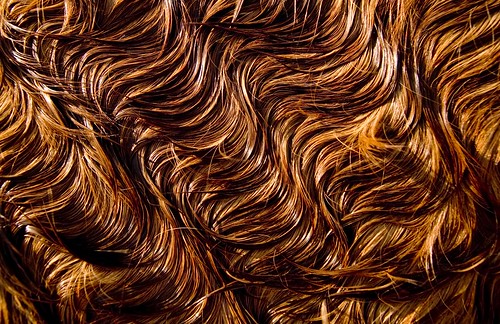
Washed the mare's winter coat and it curled up as it dried out. Warm enough on St. Pat's Day to bathe a horse!
Wednesday, February 29, 2012
Case of the Kissing Spine: Horse’s mysterious back pain leads vet on search for cure
Veterinarians may as well come with a monocle, a magnifying glass, and a Meerschaum Pipe for all the detective work needed to figure out what’s wrong with a horse.
Raymond, a 10-year-old Quarter horse, presented Dr. Cassie Leiterman of Lodi Veterinary Care with a case worthy of Sherlock Holmes.
"Raymond was a ranch horse and was now in the hands of a kid for use in showing and riding," Leiterman said. "But then he had an episode."
The episode included sweating, rapid breathing and agitation that went on for a couple of hours. The horse also showed an unwillingness to bend into turns and lameness in the rear that didn’t respond to common treatment.
Investigative work began in earnest. Raymond got a complete body palpation and movement evaluations in an effort to locate a place or source of the discomfort. Detective work continued with nerve blocks and a flexion test searching for a source of lameness.
"Most of the tests were negative or unremarkable," Leiterman said. "That left us with the visual evaluation and the results of the palpation."
During the body palpation exam, Raymond showed stiffness in his neck and a pain reaction to pressure on his back with possible muscle atrophy. Leiterman wondered if a poor saddle fit was causing some of the problem.
"They were using three different saddles on Raymond," Leiterman said. "And the saddle the little girl was using was the worst. Two out of the three saddles fit very poorly, and that’ll often cause back pain."
Poor saddle fit alone didn’t fully explain the extent of Raymond’s issues. Through a process of deduction, Leiterman kept returning to his back, where Raymond continued to display sensitivity to pressure.
It was decided to take radiographs of the spine. A horse’s spine isn’t the easiest thing to get a picture of, Leiterman said, but you can usually get enough of a shot to view most of the structure. Raymond was set up and pictures taken.
The pictures revealed that the dorsal spine in Raymond’s back had a defect. Where there should be space between the dorsal spines, X-rays of Raymond indicated the bones were touching each other.
"We call this Kissing Spine, and it’s very painful," Leiterman said. "Now that we knew what was causing the problem; what do you do about it?"
Kissing Spine has no specific cure, but certain techniques can help with pain management. Common equine pain reliever Phenylbutazone (also known as bute) is one place to start.
Leiterman said there also are more aggressive approaches. An intravenous zoledronic acid treatment is among the new methods being used to restore bone tissue. Raymond also could receive steroid injections, mesotherapy, muscle relaxers or undergo physical therapy, chiropractic care or acupuncture.
"Raymond was born this way so he’s always going to need treatment and management of his problem," Leiterman said. "We came up with a plan and now Raymond is back to work, and the little girl is very happy."
The plan included the mesotherapy (a treatment that stimulates the mesoderm, or middle layer of skin), steroid injections and some shockwave therapy, along with patience and constant awareness of the condition.
"Raymond is ready to take the little girl to the shows this summer," Leiterman said.
Case closed.
Wednesday, February 22, 2012
Conformation over function? Presenters remind horse breeders of value of genetics
 |
| Brad Kerbs |
 Your horse begins to limp or develops a stiffness that starts to get worse. Then the quest begins for what's wrong and you're working with veterinarians, farriers and other equine professionals. Money is being spent and riding time is lost.
Your veterinarian will evaluate your horse carefully. There will be visual evaluations, radiographs, perhaps ultrasound readings, nerve blocks and more until a suitable explanation for the issue is found. Along the way you're making decisions and paying the bills.
Depending on what the specialists find, you'll be given options for treatment or correction. Many structural issues are fixable with good hoof care or even surgery.
Many of the possible structural issues horses have or develop, along with potential fixes and preventions, were the topic of a recent seminar held at UW-Madison and presented by the School of Veterinary Medicine.
Dr. Elizabeth Santschi of The Ohio State University outlined a score or more of structural defects found in horses of all breeds and ages and outlined the causes, diagnostic processes, and many of the methods for helping horses and their owners repair or treat such maladies.
Santschi offered a long list of "carpal deviations" including rotation, offset knees, valgus, varus, toe in, toe out, knock knees, base narrow, base wide, sickle hock, post legged, and camped under.
"A combination of deviations is very common," Santschi said. "A young horse may grow out of some of the deviations but an older horse may need evaluation and treatment."
The first structural evaluation should take place when a foal is 3 to 4 weeks old. At such a young age, some of the potential problems are fixable with time and/or adjustments to hooves. At 3 months, however, the young animal will resemble its conformation at 3 years, and you can more accurately find and address structural deviations.
"No offense to the veterinarians here today, but I don't want to have my horses in the vet clinic getting corrective this and corrective that," said Brad Kerbs, an internationally known equine evaluator and judge. "Some of the horses we've seen today should never be bred."
While nutrition and performance can contribute to structural deviations, Kerbs said horse owners and breeders should do everything they can to assure their horses are structurally sound. When in the market for a new horse, do complete exams before you buy, and if you're breeding horses make sure you're not creating issues genetically.
"Conformation is not about criticizing or picking on a horse," Kerbs said. "It's to evaluate the horse. I think you should look first for what you like."
Kerbs explained that some parts of judging a horse for conformation are highly objective. You can take measurements to determine accurately the right lengths and proportions for the breed and age of an animal. Other evaluations are more subjective and involve close observation of how a horse moves and handles.
"Some of the more subjective measurements can be judged on a scale from one to 10," Kerbs said, "but it's not only about a horse that looks good, it's about the biomechanical function of the horse. I don't want to spend money on taking animals to the vet clinic. Just because a colt has two sound testicles doesn't mean he should be used as a stud."
Separating a genetic deficiency from something caused by injury or use isn't always easy, said Santschi. It's clear that structural abnormalities can make a horse more susceptible to certain conditions, but there often isn't a clear divide.
"Does form equal function? Absolutely," she said. "But there are things we can try to fix when we have concerns, and there are things we can't change. Are we breeding for conformation or function?"
What it boils down to is making an effort to breed sound horses. People in the market for a horse also need to take a close look at the prospect and come up with solid judgments based on the best and most objective information possible.
Altering what genetics have created is an expensive process.
Thursday, February 16, 2012
Subscribe to:
Posts (Atom)